

Why Reparenting Became the Missing Piece
Part 2: What Reparenting Made Possible

If Part 1 was about the “no” to reparenting, this second post is about what happened when I finally began turning toward the parts of me who had concerns. Not to fix them, but to connect with them.
(If you missed it, you can read the first part here.)
Meeting my inner family and connecting to a grounded presence inside that could care for them changed everything. It was easier to care for them than to care for “Bonnie.” Seeing their innocence and good intentions awakened a tenderness toward myself that I didn’t know I had.
What also helped was learning how I was contributing to my inner child getting hurt. One afternoon early in my reparenting journey, I was telling my mentor Jane what my inner critic had been saying in the wee hours of the night before. Her eyes opened wide.
“When you listen to your inner critic, you’re wounding your little girl,” she said.
My face fell.
“You’re bonded,” Jane said, holding her index fingers pressed together.
She eased them apart.
“You need to catch it right away.”
I wanted a reminder of how the dynamic worked: that well-meaning but relentless voice running unchecked, and my inner child left alone with the impact. I was so identified with the critic that it seemed like the truth about me, not a part of me.
So, when I got home, I sketched a simple stick-figure drawing: myself in the center, a small critic perched over my left shoulder with dashes spilling from its mouth, and my little girl below on the right, eyes downcast.
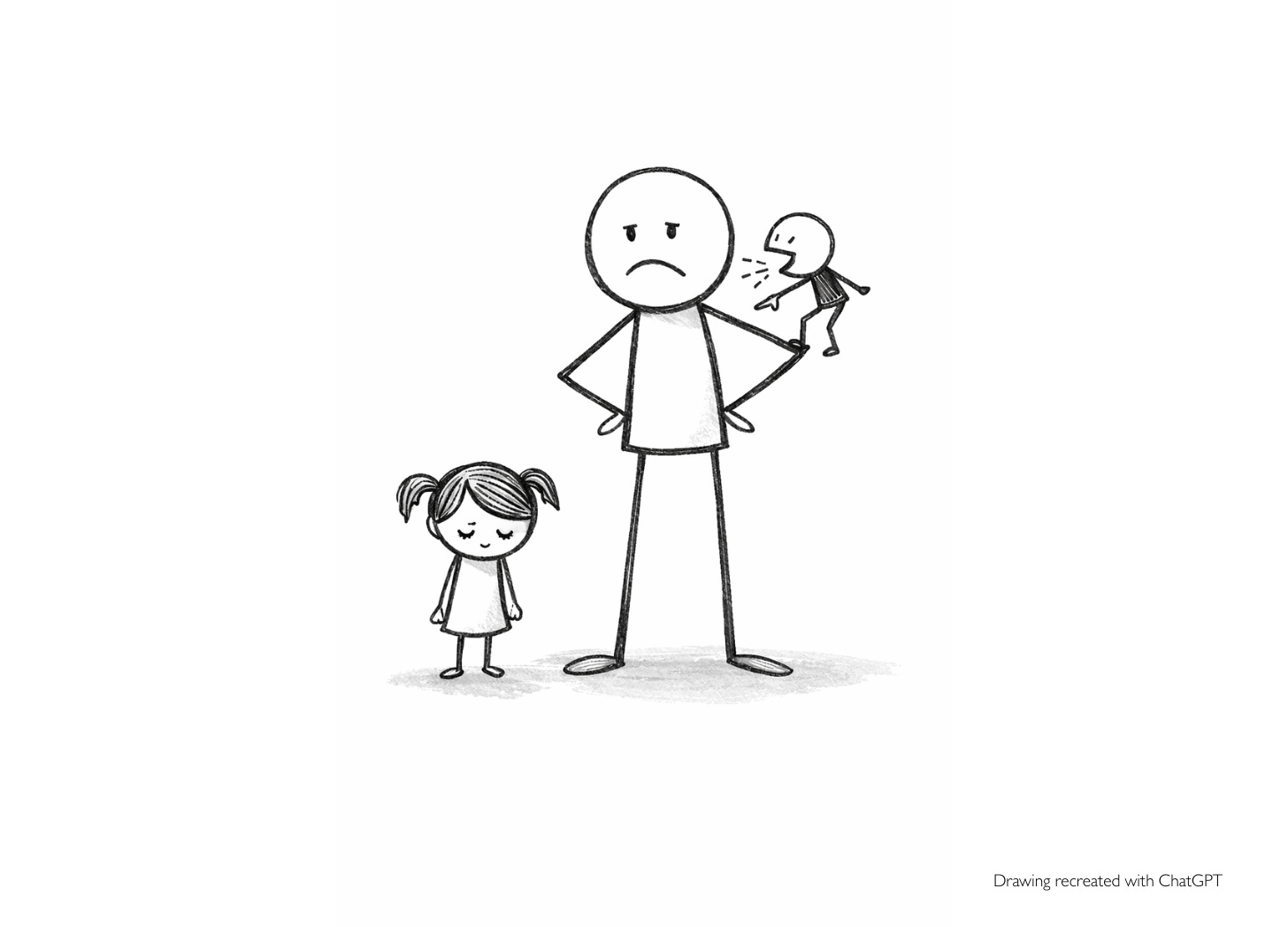
Seeing it laid out like that was painful, and clarifying. It helped me understand how much harm was happening simply because no one was intervening. That recognition helped me to turn toward this work more fully.
Luckily, I had the help of a community and great mentorship. With their support, I learned to set a loving boundary with my critic and to do the slow, important work of building trust with my inner teenager and little girl.
As I began turning toward these parts, instead of trying to override or outrun them through self-improvement, my critic eased.
My teen reached for her flamethrower less often.
My inner child began to trust me.
It slowly dawned on me that I didn’t need to fix myself.
I needed to show up for the ones inside me who had been alone for far too long.
The Parts Who Say “Not So Fast”
Over time, I began to see that the parts pushing back hardest against reparenting weren’t my most vulnerable parts, but the ones that had spent years protecting them.
The inner critic. The inner teenager. The self-sufficient part that didn’t trust anyone.
Once I could understand what those parts were guarding, their “no” to reparenting made sense. The objections weren’t refusals, they were questions — about safety, trust, and whether I was actually going to show up.
Here’s what those protective parts wanted to know. Yours might have similar questions:
Do you respect my concerns and my job, or are you trying to get rid of me?
If I step back, will the vulnerable parts be cared for or abandoned?
Are you reliable, or will I have to clean up the mess again?
Many of the practices I tried before reparenting (and continue to do) were wonderful. I threw myself into them with the secret hope they would be the silver bullet.
What I couldn’t see at the time was that my inner critic and other well-meaning protective parts were often running the show. They wanted me to present a version of myself that would be liked and not abandoned — a strategy they learned early, and one they believed was necessary for survival.
But reparenting, like those other modalities, isn’t about self-improvement or performance. It’s about relationship and authenticity.
It begins when we can hear pain not as a problem to solve, but as a signal that a part of us is asking, “Are you here with me now?”
That’s why my mentor saying, “Honey, you’re wounded,” was such a relief.
Honoring the Parts That Have Concerns About Reparenting
If you feel annoyed, resentful, scared, skeptical, or overwhelmed by the idea of reparenting, you’re in good company.
Many people I’ve worked with felt that way at first. I did too.
Those reactions may be coming from parts that learned to cope. They kept things moving when sitting with feelings wasn’t safe, and they’re not convinced that turning inward will actually help, or may worry it could stir up more than you can handle.
When parts of us aren’t on board with reparenting, they’re often responding to the same concerns I named earlier.
Even when the surface objection looks different (“This is dumb,” “I don’t have time,” “I don’t need this”), underneath it’s often coming from the same place. These parts are resourceful. They’ve been protecting you for a long time, and know many ways to plead their case.
And honestly? You don’t need all of you to want reparenting. Some parts may bristle, doubt, or roll their eyes. That’s normal.
It’s also okay if reparenting isn’t your path. Or if it isn’t your path right now.
In one of my introductory reparenting workshops, a woman had a visceral reaction of disgust when I gave an example of healthy parenting. It turned out it was her inner teenager, a part who had learned to distrust kindness because kindness in her childhood was often followed by harm.
What helped her see the potential in reparenting was meeting her reaction with curiosity and compassion. Her “no” made perfect sense once we could see who it belonged to. And when that access is hard to find alone, support can help.
Reparenting works best when we do it because we want our inner family members to suffer less, not because we think we should or have an agenda.
Our inner kids tend to be remarkably good at sensing when caring comes with strings attached.
But when we treat ourselves with gentleness and let things unfold at a pace that is kind to our inner family, we’re already reparenting.
Reflection Prompts:
How do you recognize when a “no” inside you comes from a part that is trying to protect you, and when it’s a sign that a particular path isn’t right for you?
If a part of you worries about or objects to reparenting, what are they concerned would happen if you tried it out?